
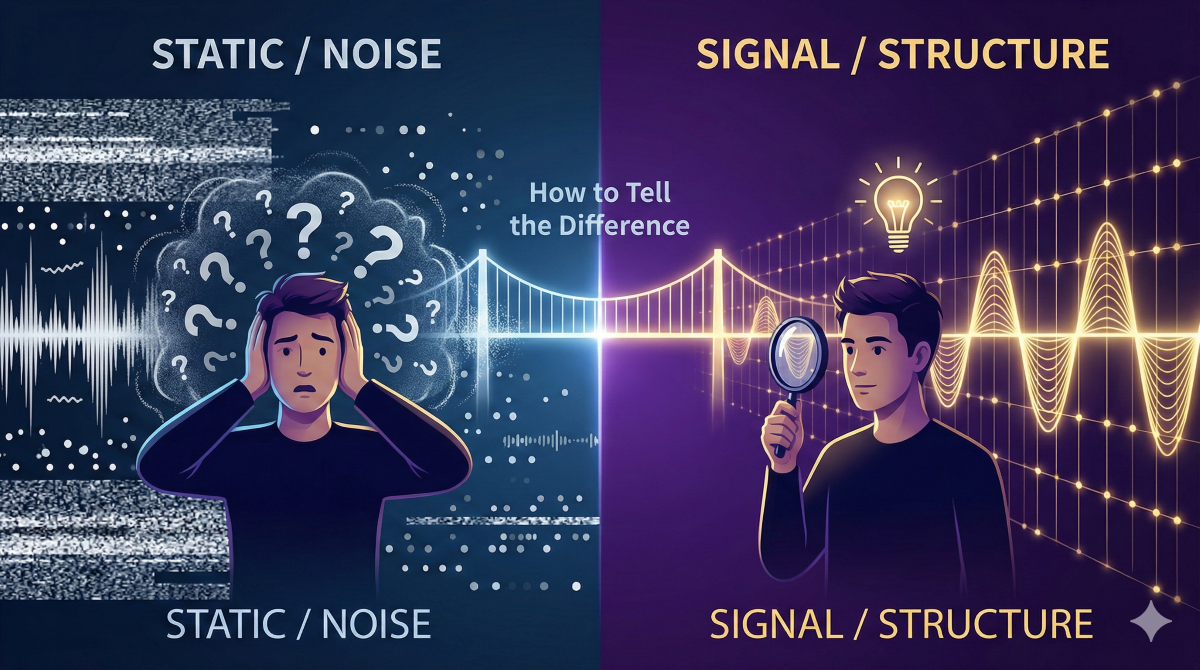




Have you ever looked up at the sky and seen a cloud that looked exactly like a rabbit? Or perhaps you were listening to the radio and thought you heard a voice in the white noise between stations? Your brain is a wonderful tool, but it has a very specific habit: it hates randomness. It wants everything to have a reason, a shape, or a “structure.”
A smart friend would tell you that the world is full of “noise”—random events that happen for no reason at all. But because we want to feel in control, we often mistake that noise for a “signal,” which is a real, meaningful pattern. In 2026, as we deal with more data than ever before, learning how to tell the difference between the two is the most important skill you can have.
The Brain as a Pattern Machine
To understand why we make this mistake, we have to look at our ancestors. Thousands of years ago, noticing a pattern was a matter of life or death. If a human saw the grass move and thought, “That might be a tiger,” and ran away, they survived. Even if it was just the wind, it was safer to assume it was a tiger.
Because of this, our brains became “over-tuned” to find patterns. We are programmed to find a signal even when there is only static.
In the modern world, this habit shows up in strange ways. We see a “lucky” shirt that helps our favorite team win. We see a “pattern” in the stock market after only two days of growth. We take a random accident and turn it into a “system.” This is the core of the problem: we are using a survival tool from the jungle to try and understand a complicated, random world.
What is “Noise” Exactly?
In science and math, “noise” refers to all the extra, random information that doesn’t matter. Imagine you are trying to listen to a friend talk at a very loud party. Your friend’s voice is the signal. The loud music, the clinking of glasses, and the other people shouting are the noise.
If the music is too loud, you might think your friend said “Go home” when they actually said “Phone.” You mistook the noise for a signal.
In life, noise is everywhere. It’s the random change in the weather, the tiny movements in the price of gold, or the fact that you happened to meet an old friend at the grocery store. These things are often just coincidences. They don’t have a deep meaning or a hidden rule behind them.
The Danger of “Clustering”
One reason we mistake noise for structure is something called “clustering.” Most people think that random things should look perfectly spread out. If you throw 100 grains of rice on a table, you expect them to be even.
However, true randomness is messy. In a random pile of rice, some grains will land right on top of each other, creating a little group or “cluster.” When we see that cluster, our brain screams, “Look! Those grains were put there on purpose! There must be a reason!”
This happens a lot in business and gambling. If a specific number comes up three times in a row on a roulette wheel, people start betting on it. They think they found a “hot” pattern. But it’s usually just a random cluster. The wheel doesn’t remember what happened last time. It’s just noise.
Why We Want to Believe in Structure
Mistaking noise for structure makes us feel powerful. If the world is just a mess of random events, then we can’t predict the future. That is a very scary thought for most people.
By inventing a “system” or a “reason,” we feel like we have a map. Even if the map is wrong, it makes us feel better than having no map at all. This is why people believe in superstitions or “get rich quick” schemes. They want to believe they have found the secret signal that everyone else is missing.
How to Tell the Difference
So, how can you stop yourself from being fooled by the static? A smart friend would give you these three rules:
Wait for More Data: A pattern that happens twice is a coincidence. A pattern that happens ten times might be a signal. Don’t jump to a conclusion after just one or two events.
Ask “What Else Could it Be?”: Before you decide you’ve found a secret rule, ask yourself if the result could just be luck. If you can explain it with “it was just a random accident,” it probably was.
Check the Source: Real signals usually have a logical cause. If you think a specific food makes you run faster, is there a scientific reason why? If not, it’s likely just noise.
The world in 2026 is louder and faster than ever. We are surrounded by charts, news, and “experts” telling us they have found the latest trend. Most of what they are seeing is just noise.
By training your brain to accept that some things happen for no reason, you actually become much smarter. You stop wasting your energy chasing ghosts in the static. When a real signal finally appears—a true, meaningful pattern—you will be the one who is calm enough and clear-headed enough to see it.