Goyang Insider

A Guide to Understanding Probability and Implied Probability Through Numerical Signals


Systems that rely on probability are often mistaken for prediction engines, yet their internal logic is built on pricing mechanisms. The numerical values displayed in such systems are not declarations about what will happen next. They are mathematical expressions of probability that have been adjusted to function as prices within environments where risk must be managed.

To interpret these numbers correctly, it is essential to distinguish between probability and implied probability. This mathematical conversion is a core element of Related article, which explores the logic hidden behind displayed odds. Failing to separate the two can make numerical signals feel arbitrary or misleading. Understanding the distinction reveals that these values are not guesses but components of a structured system. As discussed in the role of liquidity in probability accuracy, greater participation helps implied probabilities converge toward more reliable estimates.

Theoretical Probability: A Mathematical Perspective

Probability describes how often an outcome should occur when the same conditions are repeated indefinitely. It is a theoretical construct grounded in mathematics, not certainty. In real‑world environments—especially those involving human performance, incomplete data, or variable conditions—true probability cannot be directly observed. It must be estimated.

Thus, probability in practice is always an approximation, a model‑based representation of reality rather than a measurable truth. True probability exists independently of how people behave or how prices move; a shift in pricing does not change the underlying likelihood of an event.

What Implied Probability Actually Represents

Implied probability is derived from a system’s pricing structure. It answers the question: “What level of likelihood is suggested when this price is converted into a percentage?”

Examples of price‑to‑probability conversions:

  • A price of 2.00 implies a 50% likelihood

  • A price of –110 implies roughly 52.4%

  • A price of +150 implies roughly 40%

These figures do not describe real‑world frequencies. They describe how the system has priced the outcome based on structure, margins, and participation. Implied probability is not a prediction; it is a market‑driven output shaped by format, risk management, and demand.

Why Implied Probability Is Inflated: The Overround Effect

Many pricing systems intentionally inflate implied probabilities so that the total exceeds 100%. This inflation—often called an overround—represents the system’s built‑in margin.

In a perfectly neutral environment, the sum of all implied probabilities would equal 100%. In real systems, totals commonly reach 104% to 108%. Because of this structural expansion, implied probabilities almost always exceed true probabilities when viewed across the entire set of outcomes.

Pricing vs. Prediction

Pricing and prediction serve different purposes. Prediction aims to identify the most likely outcome with maximum accuracy, while pricing aims to maintain long‑term sustainability by managing risk across thousands of events.

Because pricing must account for demand and risk distribution, popular outcomes often receive higher implied probabilities than their true likelihood would justify. Prices are fundamentally economic signals, and their predictive value is secondary.

Summary

Separating probability from implied probability allows numerical values to be interpreted as signals, not truth statements. Human‑driven systems behave more like exchanges than forecasting tools. Price movements reflect flows of information and participation as much as they reflect likelihood. For a foundational, mathematically precise definition of probability that clarifies its theoretical basis, please see the article on Probability Theory from Wikipedia.


The Role of Liquidity in the Accuracy of Probability Estimates

Probability does not reveal itself through calculation alone. It becomes more reliable through participation. Initial estimates may be built from models and historical data, but their accuracy depends on how a system responds to them. Liquidity—the volume and diversity of participation—is the mechanism that transforms theoretical probability into a more trustworthy approximation.

This evolution often reflects the broader context of Additional information, which examines the background of gradual market expansion and the phased introduction of systemic structures. Without liquidity, probability estimates remain provisional. With liquidity, they are tested, pressured, and refined until they reflect collective judgment rather than isolated assumptions. As discussed in the dynamics of public bias and probability distortion, early estimates often contain psychological or structural distortions that only active participation can correct or amplify.

What Liquidity Means in Human‑Driven Systems

Liquidity refers to both the amount of capital or activity flowing through a system and the number of independent participants contributing to it.

  • High liquidity reflects many competing viewpoints expressed through meaningful participation, resulting in more stable and resilient estimates.

  • Low liquidity allows a small number of participants to exert disproportionate influence, producing more volatile and easily distorted estimates.

Liquidity does not guarantee accuracy, but it determines how resistant a system is to noise, bias, and extreme opinions.

Why Probability Requires Market‑Like Participation

True probability cannot be directly observed; it must be inferred. Systems that aggregate many independent perspectives allow probability estimates to evolve as new information enters.

When diverse signals interact:

  • Extreme opinions are diluted

  • Weak assumptions are challenged

  • Estimates converge toward a shared equilibrium

Liquidity forces probability to mature. As liquidity increases, it becomes harder for any single input to shift the estimate. Each new contribution must compete with the accumulated weight of prior activity, meaning only strong information can meaningfully move the system.

The “Closing Estimate”: Liquidity at Its Peak

In many probabilistic environments, the most reliable estimate is the one formed at the point of maximum participation—often referred to as the “closing” estimate.

This estimate is valued not because it is final, but because:

  1. The widest range of information has been revealed

  2. The largest number of participants has contributed

  3. The estimate has absorbed and responded to the strongest available signals

By the time liquidity peaks, the system has incorporated nearly all meaningful data, producing the most refined approximation of underlying probability.

What Liquidity Cannot Do

Liquidity improves the precision of probability estimates, but it does not create truth. It cannot eliminate randomness or prevent rare outcomes. Probabilistic systems remain approximations, and liquidity merely sharpens those approximations—it does not resolve uncertainty. Probability is always an estimate, and liquidity is a tool for refining it, not a mechanism for guaranteeing outcomes.

Summary

Liquidity plays a crucial role in transforming theoretical probability into a more accurate, resilient estimate. High liquidity stabilizes estimates by incorporating diverse perspectives and resisting distortion. Understanding liquidity clarifies why probability estimates evolve and why the most reliable estimates emerge only when participation is at its peak. For a foundational overview of the related economic theory, see the article on the Efficient-market hypothesis on Wikipedia.

Public Bias and Probability Distortion in Human‑Driven Systems

Systems built on probability often appear objective, but they are ultimately shaped by human behavior. Numerical outputs may look mathematical, yet the underlying “prices” reflect collective perception as much as statistical modeling. Public bias plays a central role in how probability signals are interpreted, reshaped, and sometimes distorted. Understanding this dynamic explains why implied probabilities can drift away from actual likelihoods.

These distortions are not accidental. They arise naturally in environments where human preference interacts with probabilistic structure. This phenomenon is particularly evident in how people perceive consecutive wins, a topic explored in Additional information, which examines the illusion of advantage that stems from outcome clustering. As discussed in the limits of single‑event probability, probability describes long‑term frequency, not individual outcomes—creating a structural gap that human behavior readily fills.

The Difference Between True Probability and Demand

True probability describes how often an outcome should occur under consistent conditions. It exists independently of opinion, popularity, or narrative. Demand, by contrast, reflects where people choose to direct their attention and resources. Human‑driven systems operate at the intersection of these two forces. They may begin with a probability estimate, but they must respond to shifts in collective behavior. When demand becomes imbalanced, the “price” moves—even if the underlying probability has not changed.

How Public Bias Manifests in Practice

Public bias refers to consistent patterns in how large groups interpret events. These patterns are emotional, narrative‑driven, and remarkably persistent across contexts. Common tendencies include favoring well‑known individuals, overvaluing recent performance, and trusting storylines more than long‑term data. These tendencies do not change what actually happens, but they do change how collective attention and resources flow through the system.

Why Systems Adjust to Public Bias

Human‑driven systems do not aim to publish the most accurate probability estimate. Their goal is to maintain stability, balance exposure, and manage risk. When collective behavior becomes lopsided, the system faces concentrated vulnerability. To reduce this imbalance, it adjusts its “prices.” These adjustments do not correct bias—they accommodate it. Implied probability shifts because human behavior shifts.

Favorite Bias and Recency Bias

Two of the strongest forms of public bias are:

  • Favorite Bias: People gravitate toward outcomes that feel safe, even when the difference in probability is small. This pushes the system to adjust its signals toward perceived certainty.

  • Recency Bias: A single impressive performance is often misinterpreted as the beginning of a trend. Systems adjust because collective behavior follows the narrative.

Even Efficient Systems Can Be Biased

Efficiency does not mean objectivity. An efficient system is one that rapidly incorporates information and demand. If demand is biased, the system will efficiently reflect that bias. Efficiency institutionalizes bias rather than eliminating it. Thus, numerical signals should be interpreted as economic indicators of attention, sentiment, and risk distribution—not as pure statements of probability.

Summary

Public bias does not change reality, but it changes the signals used to interpret reality. Probability describes how often an outcome should occur, while implied probability describes how that likelihood is reshaped by margins, demand, and human psychology. Understanding this distinction clarifies why human‑driven systems often drift away from objective likelihoods and toward the patterns of collective behavior. For a foundational look at the psychological models behind such distortions, the official summary of Nobel Prize-winning research in behavioral economics provides essential context.

The Limits of Probability in Single‑Event Outcomes

Probability is often mistaken for prediction. When people see a percentage attached to a possible outcome, they instinctively interpret it as a statement about what will happen next. But probability makes no promises about any individual event. It describes patterns that emerge only through repetition.

Understanding this structural tension is vital for analyzing any high-performance system. The inevitability of upsets in such environments is further explored in this Related article, which examines the structural necessity of loss within the framework of probability and volatility.

Probability Describes Frequency, Not Certainty

Probability applies to distributions of outcomes, not to isolated moments in time.

  • A 60% probability does not mean an event is “likely to happen next.”

  • It means that across many repeated trials, the event should occur roughly 60% of the time.

Each individual event remains uncertain. No matter how strong the probability appears, a single outcome is never guaranteed. This distinction is subtle but essential: probability governs tendencies, not destinies.

Why a Single Outcome Proves Nothing

A single event provides no meaningful evidence about whether a probability estimate was correct. If a low‑probability outcome occurs, that does not invalidate the underlying estimate; if a high‑probability outcome occurs, that does not confirm it. A single result is a sample size of one—and a sample of one contains no statistical insight. Probability cannot be judged in the moment; it can only be evaluated over time.

Variance: Why Short‑Term Results Deviate from Expectations

Variance describes how outcomes naturally spread around an expected average. Even when probabilities are accurate, short‑term results often deviate from expectations. Variance is not an error—it is the mathematical cost of uncertainty. If variance did not exist, the system would be deterministic rather than probabilistic.

Volatility: How Variance Feels Over Time

Volatility describes the emotional experience of variance as outcomes unfold.

  • High‑volatility environments produce large deviations from expectations, long streaks, and sharp swings.

  • Low‑volatility environments feel more stable and predictable.

Volatility does not change expected results. It changes how unpredictable the path toward those results feels.

Streaks Are Inevitable in Random Systems

Humans expect randomness to alternate evenly, so they assign meaning to streaks. But real random sequences naturally form clusters—a phenomenon related to the clustering illusion, where patterns in short sequences appear meaningful even though they arise from randomness itself. A streak does not indicate that probabilities have changed. It simply reflects the uneven way randomness unfolds.

Independence and Memory of Past Outcomes

Most probabilistic events are independent. That means the occurrence of one outcome does not influence the probability of the next one—a core principle of probability theory. Yet people often believe past outcomes influence future ones, falling into the illusion of momentum or the gambler’s fallacy. Probability does not “remember” the past; each event resets uncertainty.

Core Insight: Repetition Reveals Structure

Probability does not describe what will happen next. It describes what tends to happen over time. In the short term, variance dominates, making individual outcomes feel disproportionately significant. Only repetition reveals the underlying structure.

For example, understanding how odds communicate risk helps clarify why individual events can diverge from expectations even when probability is accurate—see Additional information for a related examination of risk representation in probabilistic systems.

External Perspective on Probability Misconceptions

Misinterpreting individual outcomes as proof of probability accuracy is a well‑recognized cognitive bias. According to Wikipedia’s entry on the Illusion of Validity, people frequently overestimate the predictability of events based on single outcomes rather than on aggregated data—a key trap that arises from misunderstanding how randomness and probability truly operate.

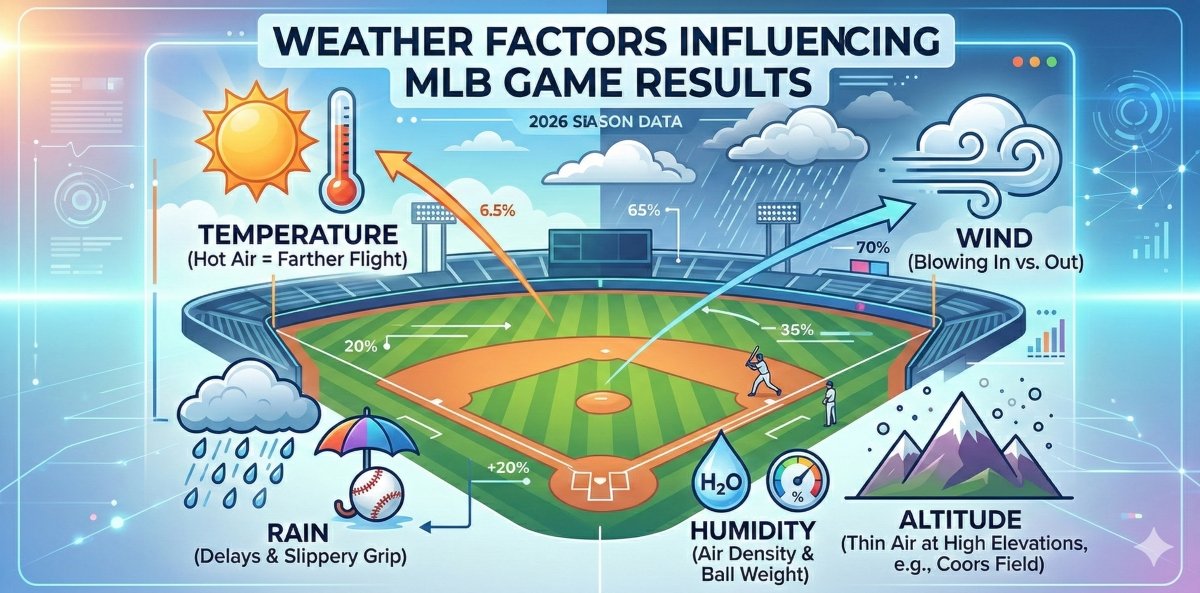
Weather Factors That Influence MLB Game Results

Baseball is a game of inches, and sometimes those inches are decided by the air itself. Unlike basketball or hockey, which are played in controlled indoor climates, Major League Baseball (MLB) is an outdoor sport. This means the weather is not just a background setting; it is an active player in every game. From the way a ball travels through the air to how a pitcher grips the leather, the elements can completely change the outcome of a match.

In 2026, teams are using more data than ever to track these changes. Understanding how the environment impacts the game can help fans and bettors see beyond the players’ skills and into the science of the sport.

Temperature: The Secret to Home Runs

One of the most important factors in any baseball game is the heat. Physicists have shown that baseballs travel much farther in warm air than in cold air. When the air is hot, the molecules are spread further apart, making the air “thinner.” This means there is less resistance or “drag” pushing against the ball as it flies.

In a hot summer game in Texas or Florida, a ball hit with the same force might travel 15 to 20 feet farther than it would in a chilly April game in Chicago. For a hitter, this is the difference between a long fly ball that is caught at the wall and a home run that clears the fence.

However, heat also affects the players. High temperatures can cause pitchers to tire out more quickly. When a pitcher is exhausted, their “velocity”—the speed of the ball—often drops, and their throws become less accurate. This is why high-scoring games are much more common during the hot months of July and August.

Humidity and the “Heavy Air” Myth

For a long time, many fans believed that “heavy” humid air made it harder for a ball to travel. In reality, science shows the opposite. Moist air is actually less dense than dry air. This is because water vapor molecules are lighter than the nitrogen and oxygen molecules they replace.

This means that on a very humid day, the ball should technically fly slightly farther. However, there is a catch. MLB now requires every stadium to use a “humidor,” which is a temperature-controlled room to store baseballs. If a ball is stored in a humid environment, it absorbs moisture and becomes slightly heavier and softer. A “wet” ball does not bounce off the bat as fast as a dry, hard ball. This technology has helped balance the game, preventing humidity from making every game a home run contest.

The Wind: A Game of Direction

Wind is perhaps the most visible weather factor. A strong gust of wind can turn a guaranteed home run into a routine out, or blow a pop-up into the stands.

  • Wind Blowing In: When the wind blows from the outfield toward the hitter, it acts like an invisible wall. It slows the ball down, keeping it inside the park. These games usually have very low scores.

  • Wind Blowing Out: When the wind blows toward the outfield, it carries the ball. Even a weak hit can sail over the fence. Pitchers hate these days because even their best pitches can be turned into home runs.

  • Crosswinds: These are the most difficult for fielders. A ball hit high in the air might start over center field but get pushed toward left field by a strong side-wind. This leads to more errors and “misplayed” balls.

In 2026, stadiums like Wrigley Field in Chicago are famous for these shifts. Fans check the wind direction before every game because they know it determines if the match will be a pitcher’s duel or a high-scoring battle.

Air Pressure and Altitude: The Coors Field Effect

Air pressure is another invisible force. At high altitudes, the air is much thinner. This is why Denver, Colorado—the “Mile High City”—is the most famous place for home runs in the world. At Coors Field, the ball encounters very little resistance.

But altitude does not just help hitters; it hurts pitchers. In thin air, a “breaking ball” (like a curveball or a slider) does not move as much. These pitches rely on the air to push the ball in different directions. Without that air pressure, the ball stays straight, making it much easier for the batter to hit.

The Pitcher’s Grip and Rain

Even a light mist can change a game. A baseball is made of leather, and when it gets damp, it becomes slippery. A pitcher needs a perfect grip to put spin on the ball. If the ball is even slightly wet, the pitcher might lose control, leading to more “walks” or even hitting the batter by mistake.

In 2026, MLB has strict rules about when to stop a game for rain. If the dirt on the “pitcher’s mound” becomes too muddy, it becomes dangerous for the players to move quickly. A slippery field can lead to leg injuries during a fast sprint to first base.

A New Era of Weather Tracking

As we move through the 2026 season, technology is helping us understand these factors in real-time. Apps now provide “Ball Flight Weather” reports that tell fans exactly how many extra feet a ball will travel based on the current conditions.

Weather is the one thing a coach cannot control. No matter how much a team practices, they are always at the mercy of the wind and the heat. By learning how these factors work, you can appreciate the game on a much deeper level. The next time you see a ball sail over the fence, remember: the batter provided the power, but the weather might have provided the help.

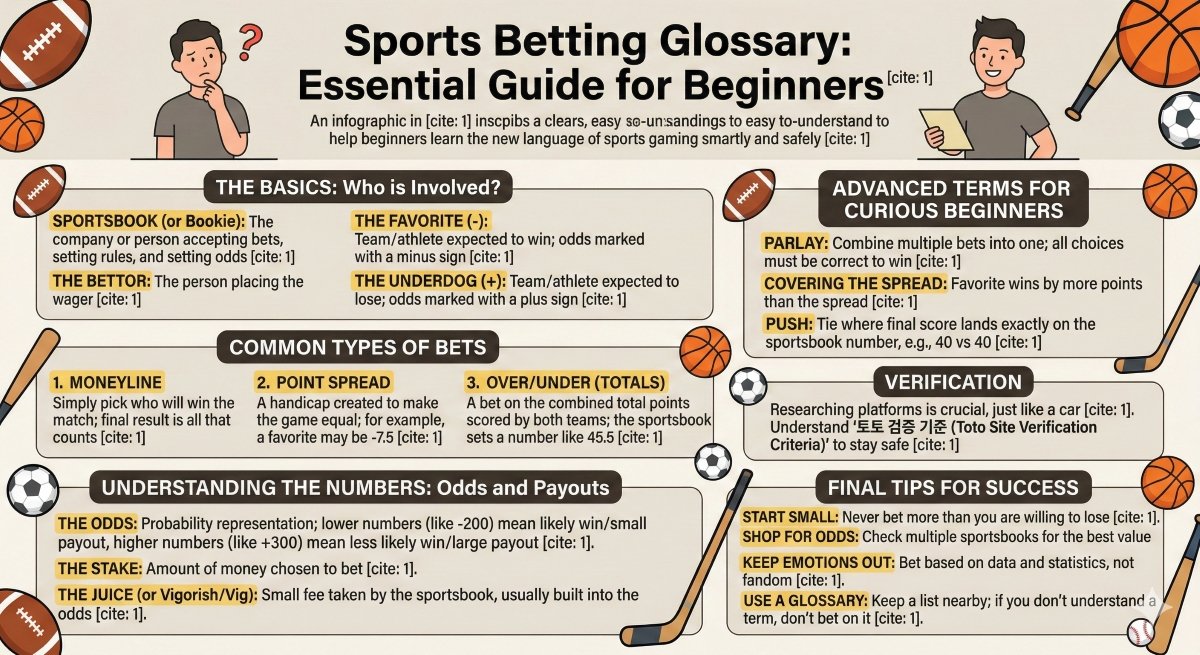
Sports Betting Glossary: Essential Guide for Beginners

Entering the world of sports gaming can feel like learning a new language. You might hear people talking about “spreads,” “vig,” or “parlays” and feel completely lost. This is very common for beginners, especially for those whose first language isn’t English. However, understanding these terms is the first step toward enjoying the game safely and smartly. This guide breaks down the most important words you need to know in simple, easy-to-understand English.

The Basics: Who is Involved?

Before we look at the numbers, let’s identify the players in this environment.

  • The Sportsbook (or Bookie): This is the company or person that accepts your bets. They set the rules and the odds for each game.

  • The Bettor: This is you—the person placing the wager.

  • The Favorite: This is the team or athlete that is expected to win. In most systems, their odds are marked with a minus sign (-).

  • The Underdog: This is the team or athlete expected to lose. Their odds are usually marked with a plus sign (+).

Common Types of Bets

When you look at a list of games, you will see different ways to play. Here are the three most popular options for beginners.

1. Moneyline

This is the simplest way to play. You are simply picking who will win the match. If you bet on a team’s moneyline and they win, you win. It doesn’t matter by how many points they win; the final result is all that counts.

2. Point Spread

This is a bit more complex. The sportsbook creates a “handicap” to make the game equal. For example, if a strong team is playing a weak team, the strong team might have a spread of -7.5. This means they must win by more than 8 points for your bet to be successful. If they win by only 5 points, you actually lose the bet. This makes even one-sided games exciting to watch.

3. Over/Under (Totals)

In this version, you don’t care who wins. You are betting on the total number of points scored by both teams combined. The sportsbook sets a number, like 45.5. You decide if the actual total will be “Over” or “Under” that number.

Understanding the Numbers: Odds and Payouts

The numbers next to the teams tell you two things: how likely an event is to happen and how much money you will win.

  • The Odds: These represent the probability. Lower numbers (like -200) mean a win is very likely, but the payout is small. Higher numbers (like +300) mean a win is less likely, but you can win a lot more money.

  • The Stake: This is the amount of money you choose to bet.

  • The Juice (or Vigorish/Vig): This is a small fee the sportsbook takes for middleman services. It is usually built into the odds. This is how the “house” makes money regardless of who wins.

Advanced Terms for Curious Beginners

Once you feel comfortable with the basics, you might encounter these words:

  • Parlay: This is when you combine multiple bets into one. For example, you bet on three different football teams to win. To win a parlay, all your choices must be correct. If even one team loses, you lose the whole bet. These are risky but offer very high payouts.

  • Covering the Spread: If you bet on a favorite and they win by more points than the spread, they have “covered.”

  • Push: This happens if the final score lands exactly on the sportsbook’s number. For example, if the over/under is 40 and the total score is exactly 40, it is a tie. You get your original money back, but you don’t win any extra.

Why Context and Verification Matter

Learning the language is just the beginning. As you spend more time looking at different platforms, you will notice that not every site is the same. Some offer better odds, while others might have different rules for how they pay out your winnings.

It is very important to understand the environment you are playing in. Just like you would research a car before buying it, you should research where you are placing your bets. For users interested in understanding how Toto Site Verification Criteria works in real cases, this reference explains the process in more detail. Having a clear set of rules for how to judge a platform is the best way to stay safe.

Final Tips for Success

  • Start Small: Never bet more than you are willing to lose. Use your first few tries as a “learning fee.”

  • Shop for Odds: Different sportsbooks might have slightly different numbers. Checking two or three places can help you get the best value.

  • Keep Emotions Out: Don’t just bet on your favorite team because you love them. Look at the data and the statistics.

  • Use a Glossary: Keep a list like this one nearby when you are looking at a betting board. If you don’t understand a term, don’t put money on it.

The world of sports gaming is filled with specialized words, but they aren’t impossible to learn. By mastering the basic terms like Moneyline, Spread, and Odds, you can participate in the conversation with confidence. Remember, the goal is to have fun and stay informed.

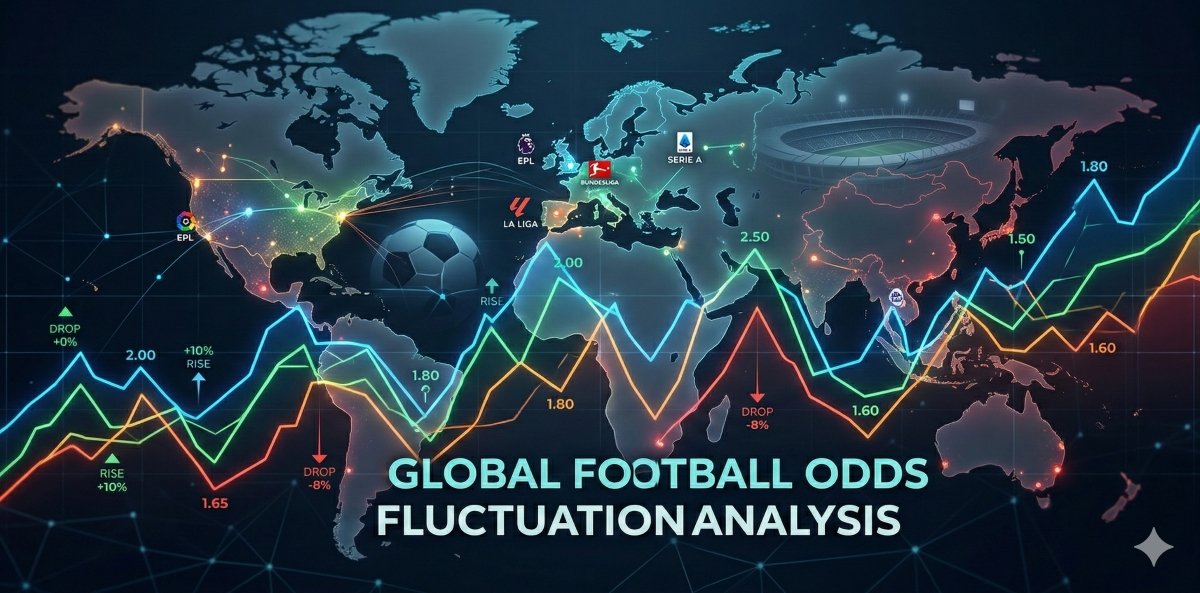
Analysis of Odds Fluctuation Patterns by International Football Leagues

In the world of sports betting, the numbers you see on a screen are never truly still. They breathe, move, and shift like the prices in a stock market. This movement is known as “odds fluctuation.” If you have ever noticed the price of a team changing from 2.00 to 1.80 just an hour before kickoff, you have witnessed a fluctuation pattern.

In 2026, understanding these patterns across different international football leagues is no longer just for experts. With real-time data and AI, regular fans can now see why these changes happen. Each league has its own rhythm, and by looking closely, we can see how the “market” reacts to the drama of the football world.

Why Do Odds Move at All?

Before looking at specific leagues, it is important to understand the engine behind the movement. Odds change because bookmakers want to balance their books. If everyone is betting on Real Madrid to win, the bookmaker will lower the odds for Madrid and raise them for their opponent. This encourages people to bet on the other side, protecting the bookmaker from a huge loss.

However, money is not the only factor. Information is just as powerful. A sudden injury during a morning training session, a change in the weather, or even a coach’s tactical decision can cause the odds to “drift” or “drop” in seconds.

The English Premier League: High Volume and High Volatility

The English Premier League (EPL) is the most popular league in the world, and its betting market reflects that. Because so many people around the world bet on the EPL, the odds are incredibly “volatile.” This means they move often and sometimes very sharply.

In the Premier League, even the bottom-ranked teams are seen as dangerous. This depth creates a unique pattern. When a top team like Arsenal or Manchester City plays away from home against a mid-table side, the odds often fluctuate based on the starting lineup. In early 2026, we saw cases where a single injury to a star player like Erling Haaland caused the win probability to drop by 10 percent in under an hour.

Because the volume of money is so high, the EPL market is also very efficient. This means that the odds usually settle at a very “fair” price by the time the match starts. If you see the odds dropping fast on a Friday night, it is usually because professional “syndicates” have placed massive bets based on new data.

Spanish La Liga: The Predictability Factor

Historically, the Spanish La Liga has been seen as more predictable than the Premier League. For many years, Real Madrid and Barcelona dominated so heavily that their odds rarely moved much. However, in 2026, the pattern is changing.

Data from the 2025-2026 season shows that the “middle” teams in Spain have become much more defensive and organized. As a result, we are seeing more fluctuations in the “Over/Under Goals” market rather than just the win-draw-loss market. If a top Spanish team is playing a team known for a “low block” defense, the odds for “Under 2.5 goals” often drop as the match gets closer.

The Impact of the Transfer Window

The January 2026 transfer window had a massive impact on league odds. When a team signs a world-class defender or a new goalkeeper, their odds for the rest of the season often shift immediately.

For example, when a struggling team in the German Bundesliga signs a new star striker, their odds of winning their next few matches might drop significantly. This is because the market “prices in” the new talent. Bettors who follow transfer news closely can often find “value” by placing bets before the bookmakers have fully adjusted their models to the new squad strength.

Regional Differences in Market Sensitivity

Different regions react to information at different speeds. In the 2026 football landscape, Asian handicap markets often react much faster than European “1X2” markets. This is because the Asian markets are built for professional high-stakes traders who use AI to spot tiny changes in team form.

  • European Markets: Often move based on “public” news, such as a major injury reported on TV.

  • Asian Markets: Often move based on “hidden” data, such as ball recovery speeds or fatigue markers that only professional analysts track.

Dr. Hany Farid, a specialist in digital patterns, notes that as AI models get better, the window of time to find “incorrect” odds is getting smaller. The market is becoming smarter every single day.

Using AI to Spot “Dropping Odds”

In 2026, many bettors use tools to track “dropping odds.” If a team’s odds fall from 2.50 to 2.10 across ten different bookmakers at the same time, it is a strong signal. It tells you that something important has happened—perhaps the opponent’s best player is sick, or a heavy rainstorm has started at the stadium.

Tracking these patterns across international leagues allows you to see which leagues are “stable” and which are “chaotic.” For example, the French Ligue 1 often shows very stable odds until the final 24 hours before a game, while the Italian Serie A often sees fluctuations early in the week as tactical rumors spread through the media.

The Future of Odds Analysis

As we look toward the rest of 2026, the goal of odds analysis is shifting. It is no longer just about picking a winner. It is about understanding the “well-being” of the market. By watching how odds move, we can see the collective intelligence of millions of fans and experts.

Whether you are looking at the Champions League or a local international league, remember that the numbers tell a story. They reflect the injuries, the transfers, the weather, and the money flow. By learning to read these patterns, you can gain a much deeper understanding of the beautiful game and the complex world that surrounds it.

How Half-Time / Full-Time Bets Work: A Simple Guide for Beginners

If you have ever looked at a sports betting site, you might have seen a category called “HT/FT.” This stands for Half-Time / Full-Time. While it might look confusing at first, it is actually one of the most popular ways to find better value in a match where one team is a heavy favorite.

This guide will explain exactly how these bets work, the different combinations you can choose, and some simple tips to help you get started.

What Exactly is a Half-Time / Full-Time Bet?

In a standard bet, you usually just predict who will win the game at the end of the 90 minutes. This is often called a “Match Result” or “1X2” bet.

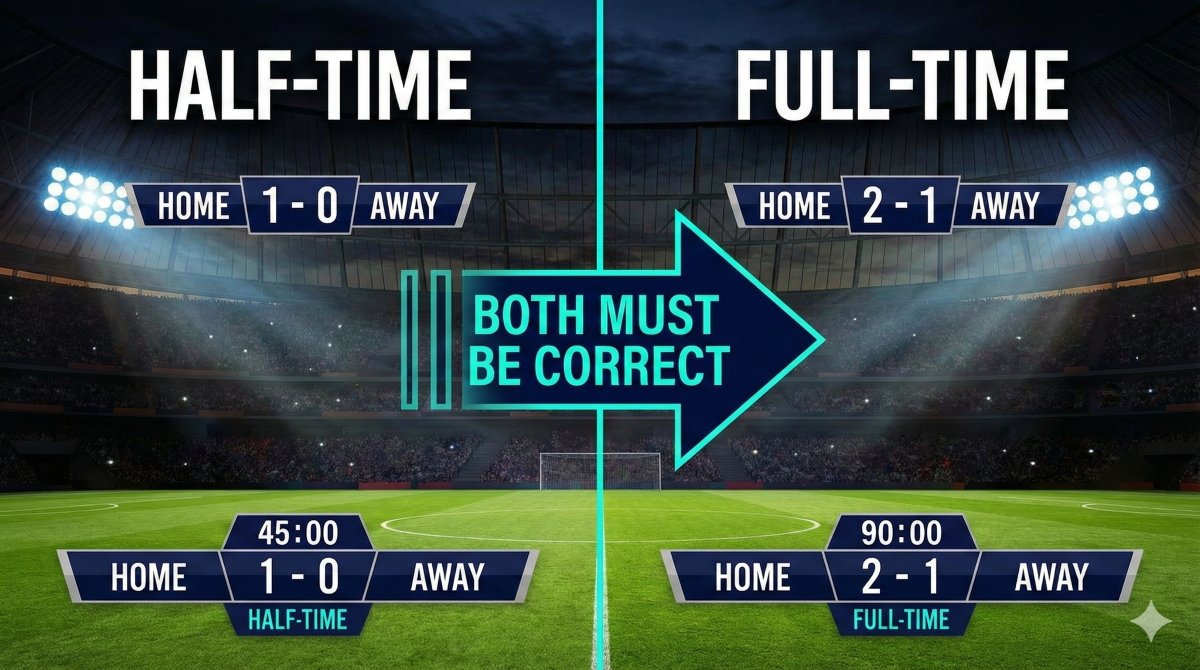
A Half-Time / Full-Time bet is more specific. To win, you must correctly predict two things at the same time:

  1. Which team will be leading (or if it will be a draw) at half-time.

  2. Which team will be the winner (or if it will be a draw) at full-time.

Think of it as two bets joined together into one. If you get the half-time result right but the final result wrong, you lose the bet. You must get both parts correct to receive a payout.

The Nine Possible Combinations

In a game between Team A and Team B, there are nine different ways a match can go in an HT/FT format. Here is a simple breakdown of what they mean:

  • Home / Home (1/1): The home team leads at half-time and wins the game.

  • Draw / Home (X/1): It is a draw at half-time, but the home team wins the game.

  • Away / Home (2/1): The away team leads at half-time, but the home team makes a comeback and wins.

  • Home / Draw (1/X): The home team leads at half-time, but the game ends in a draw.

  • Draw / Draw (X/X): It is a draw at half-time and remains a draw at the end.

  • Away / Draw (2/X): The away team leads at half-time, but the game ends in a draw.

  • Home / Away (1/2): The home team leads at half-time, but the away team comes back to win.

  • Draw / Away (X/2): It is a draw at half-time, but the away team wins the game.

  • Away / Away (2/2): The away team leads at half-time and wins the game.

Why Do People Use This Bet?

You might wonder why someone would choose this instead of a simple match winner bet. The main reason is better odds.

Imagine a very strong team is playing against a very weak team. The odds for the strong team to win might be very low (for example, 1.20). This means you won’t make much profit.

However, if you bet on that strong team to be leading at half-time and win at full-time (Home/Home), the odds will be much higher (perhaps 1.70 or 2.00). This is because it is harder for a team to lead for the whole game than it is just to win eventually.

Common Strategies for Beginners

If you want to try HT/FT betting, here are some practical ways to look at a match:

1. The “Strong Favorite” Strategy

If a top-tier team is playing at home against a struggling team, they often try to score early to settle the game. In these cases, “Home / Home” is a common choice. You are betting that the favorite will dominate from the very beginning.

2. The “Defensive First Half” Strategy

Some teams are very good at defending but don’t score many goals. They often play conservatively in the first half to stay safe. If two defensive teams are playing, “Draw / Draw” or “Draw / Home” are popular options. You are predicting a slow start with the action happening later in the game.

3. The “Comeback” Strategy (High Risk)

Options like “Away / Home” or “Home / Away” offer the highest payouts. This is because it is rare for a team to lead at half-time and then lose the entire game. These are risky bets, but they can be used if you know a team has a history of starting slowly but finishing very strongly.

Important Rules to Remember

Before you place your first HT/FT bet, keep these two simple rules in mind:

  • 90 Minutes Only: Just like most football bets, HT/FT bets only count the “regular time” (90 minutes plus injury time). If the game goes into extra time or penalties (like in a cup final), those extra minutes do not count toward your bet.

  • Both Must Be Right: We cannot stress this enough. If you predict Draw/Home and the home team is winning 1-0 at half-time, your bet is already lost, even if they win the game 5-0 at the end.

Summary Table: Quick Reference

Bet TypeHT ResultFT ResultDifficulty
Home / HomeHome LeadsHome WinsMedium
Draw / HomeTie ScoreHome WinsMedium/High
Away / HomeAway LeadsHome WinsVery High
Draw / DrawTie ScoreTie ScoreHigh

HT/FT betting is a great way to add excitement to a match and find better value than a standard win bet. By understanding how the two halves of a game connect, you can make smarter choices and manage your budget more effectively.

Start with small amounts while you learn how different teams behave in the first and second halves. With a bit of research and patience, you can master this popular betting style.

Why Probability Numbers Feel Predictive But Aren’t

Probability numbers often feel like forecasts. When people see a numerical likelihood attached to an outcome, they instinctively interpret it as a statement about what will happen next. A higher number feels reassuring. A lower number feels dismissible. That reaction is intuitive—but it’s also misleading.

These numbers are not promises about the future. They describe relative likelihood under uncertainty, often within systems designed to balance risk rather than predict outcomes. A detailed analysis of these misconceptions can be found in this Related article, which explores the danger of believing an outcome is “due” simply because of past results.

Why the Brain Turns Likelihood Into Narrative

Humans are pattern-seeking by default. When presented with a probability, the brain does not store it as a range or distribution. It immediately converts it into a story about what should happen.

This tendency is reinforced by feedback. People see a probability, then later observe an outcome. Over time, the mind links the number to the result, as if the probability itself were being tested. What gets overlooked is that uncertainty was never removed. Probability describes frequency across many repetitions, while human experience unfolds one event at a time. That mismatch creates a persistent illusion of surprise.

Why Likelihood Is Not the Same as Expectation

A probability answers how often something would occur across many similar situations. It does not state what must happen now.

Expectation, however, is emotional. Once someone commits to a decision, likelihood quietly turns into entitlement—this was supposed to work. When the expected outcome fails to appear, the response is disappointment or suspicion, even though the result was statistically ordinary. Emotional commitment converts descriptive numbers into personal promises.

Why Short Sequences Create False Judgments

Short sequences dominate perception. Unlikely events stand out. Likely outcomes that fail to appear feel like errors.

Systems that resolve outcomes quickly encourage people to evaluate probabilities one event at a time. This trains the brain to score numbers as “right” or “wrong,” even though probabilities were never meant to be evaluated that way. This dynamic is amplified in feedback-heavy environments, where confidence grows faster than calibration—a mechanism explored further in Additional information.

Why Accurate Numbers Can Still Feel Misleading

Even perfectly calibrated probabilities produce streaks, clusters, and gaps. This is variance—not error.

Humans expect randomness to alternate smoothly. When it does not, suspicion arises. Accurate probabilities feel wrong because lived experience does not resemble statistical intuition. Accurate numbers do not guarantee short-term satisfaction; they guarantee long-term correctness. That difference is uncomfortable.

Why Pricing Distorts Interpretation

Probability numbers often appear inside pricing systems rather than forecasting tools. They reflect balance, exposure, and system equilibrium—not just likelihood.

When priced probabilities are interpreted as predictions, confusion is inevitable. The number feels like a claim about reality when it is actually a signal about structural balance. The number did not fail; the expectation attached to it was misplaced.

Why Outcomes Rewrite Memory

Once an outcome is known, memory changes. If the event occurs, the probability feels obvious in hindsight. If it does not, the number feels deceptive.

This retrospective certainty strengthens confidence without improving understanding. Recent 2024 cognitive research shows that hindsight bias combined with numerical framing significantly inflates perceived understanding without improving calibration, as detailed in a behavioral science review published by Annual Review of Psychology, 2024.

Why Probability Is Better Read as Uncertainty, Not Direction

Probability numbers describe uncertainty, not destiny. They outline a range of possible futures without selecting one.

The persistent misunderstanding is not about intelligence. It is about presentation, feedback, and the discomfort of living inside uncertainty. Probability was never meant to tell you what will happen next. It was meant to describe how uncertain the situation is before anything happens at all.

Stopping Is a Structural Problem, Not a Willpower Problem

Why Disengagement Fails Even When Motivation Exists

Difficulty stopping an activity is commonly explained through personal shortcomings. People are told they lack discipline, focus, or self-control. This explanation feels intuitive because it places responsibility on individual choice. However, it fails to account for how many modern systems are actually designed.

In reality, stopping is often difficult not because of weak willpower, but because the structure of the system makes continuation easier than disengagement. When systems are built so that activity persists by default, stopping becomes an active task rather than a natural outcome. This perspective is explored in depth in this Additional information, which argues that disengagement is a matter of design architecture rather than personal willpower.

What Stopping Actually Requires

Stopping is not a single action. It is a sequence of conditions that must align at the same time. For disengagement to occur, a system must allow:

  • Recognition that stopping is desirable

  • A clear and visible exit point

  • Low friction to disengage

  • No immediate penalty for stopping

  • Absence of automatic continuation

If even one of these elements is missing, stopping becomes difficult regardless of motivation. Willpower can initiate intent, but it cannot compensate for structural resistance indefinitely.

Why Continuation Becomes the Default

Many modern systems are built so that doing nothing results in continued engagement. This design choice shifts effort away from continuation and places it on stopping. Common structural features that favor continuation include automatic progression from one state to the next, endless endpoints, and continuous availability without closure. In such environments, continuation requires no decision, while stopping requires conscious interruption.

Cost Asymmetry Between Continuing and Stopping

A central structural issue is cost asymmetry. Continuing often carries little immediate cost, while stopping introduces short-term friction. Stopping may involve loss of momentum, interruption of feedback loops, or emotional discomfort from breaking continuity. When costs are uneven, behavior follows the path of least resistance. This is not a failure of resolve, but a predictable response to incentive structure.

Decision Fatigue and Cognitive Load

Stopping demands cognitive effort. It requires evaluation, justification, and sometimes emotional regulation. Continuation, by contrast, often bypasses deliberation entirely. In systems defined by rapid feedback and repeated micro-choices, cognitive resources are steadily depleted. As decision fatigue accumulates, default behaviors dominate. This is closely tied to how small, repeated actions quietly replace conscious choice over time, a mechanism explored further in Related article.

Why Willpower-Based Explanations Fall Short

Willpower assumes that stopping is equally accessible at any moment. Structurally, this is rarely true. If stopping requires more steps than continuing or interrupts reinforcement, then willpower must be applied repeatedly, not once. Structural pressure accumulates, while personal effort remains finite. This explains why people can sincerely want to stop and still continue.

Delayed Feedback and the Absence of Stopping Signals

Another structural barrier is delayed feedback. Systems often postpone the signals that would normally prompt disengagement. Examples include gradual fatigue instead of immediate discomfort and diffuse consequences instead of clear boundaries. Without visible stopping cues, engagement continues through inertia rather than intention.

The Role of Incremental Continuation

Continuation rarely appears as a long commitment. Instead, it advances through small extensions:

  • One more interaction

  • One more cycle

  • One more update

Each extension feels insignificant, but collectively they erase clear endpoints. When boundaries disappear, stopping becomes ambiguous—and ambiguity favors continuation.

Structural Framing Versus Moral Framing

Moral framing asks why individuals fail to stop, whereas structural framing asks why stopping is difficult in the first place. Structural analysis focuses on defaults, exit availability, and feedback timing. This shift removes blame from individuals and places responsibility on system design. Recent 2024 behavioral research emphasizes that habit persistence is strongly shaped by environmental defaults and friction rather than motivation alone, a conclusion highlighted in the APA Monitor on Psychology’s 2024 review.

Summary

Stopping fails because systems are structured so that continuation is effortless and disengagement is costly. When continuation is automatic and stopping requires effort, behavior stabilizes around persistence. This outcome is structural, not psychological. Stopping is not simply the reverse of starting; it requires visible endpoints and intentional friction.